
At some point, almost everyone feels the desire to reinvent themselves.
You imagine becoming more confident.
More disciplined.
More aligned with the life you want.
You promise yourself this time will be different.
And for a while, it is.
You start new habits. You feel motivated. You think differently.
But slowly, something familiar happens.
Old reactions return.
Old doubts resurface.
Old patterns quietly come back.
And you wonder:
Why do I always become my old self again?
The answer isn’t lack of willpower.
It’s identity.
Why Reinventing Yourself Feels So Hard
Most personal growth advice focuses on behavior.
Change your habits.
Change your thoughts.
Change your routine.
But behavior sits on top of something deeper — your self-concept.
Your brain is designed to maintain consistency with who you believe you are.
So when actions conflict with identity, your nervous system pulls you back toward familiarity.
Not because you’re failing.
Because your identity hasn’t changed yet.
You’re Not Starting Over — You’re Updating Your Identity
Reinventing yourself doesn’t mean becoming someone completely new.
It means expanding who you already are.
Your higher self is not a future version waiting somewhere ahead.
She is a pattern that becomes stronger each time you act in alignment with her.
This process is called identity shift.
Instead of forcing change, you gradually teach your brain a new normal.
The 4 Stages of Identity Shift
1. Awareness
You recognize that current patterns no longer represent who you want to be.
2. Experimentation
You begin small behavioral shifts aligned with your future self.
3. Evidence
Repeated actions create proof that change is safe and possible.
4. Integration
New behaviors stop feeling forced — they become natural.
Most people quit during stage two because results feel invisible.
But this is exactly where identity transformation is happening.
Why You Keep Returning to Old Patterns
Your brain values familiarity over improvement.
Even uncomfortable identities feel safe because they are predictable.
Without a structured process, growth relies on motivation — and motivation always fluctuates.
This is why reinvention feels temporary for so many people.
Real transformation requires repetition with intention.
Not intensity.
How to Reinvent Yourself Without Burnout
Instead of trying to change everything at once, focus on identity-based actions:
- Make one aligned decision daily.
- Keep small promises to yourself.
- Adjust self-talk gently instead of forcing positivity.
- Act slightly differently than your past self would.
Small shifts repeated consistently reshape identity faster than dramatic resets.
At this stage, many people realize that understanding change intellectually is easier than applying it consistently. Identity shift becomes powerful when small reflections and aligned actions are practiced regularly — not perfectly.
The Missing Piece Most People Overlook
Understanding identity shift intellectually is powerful.
But embodiment happens through guided repetition.
Structure removes decision fatigue.
Reflection creates awareness.
Consistency builds evidence.
This is why having a framework often accelerates transformation far more than motivation alone.
Ready to Go Deeper?
If this article resonated with you, it may be because part of you already recognizes that change isn’t about forcing motivation — it’s about gently shifting identity over time.
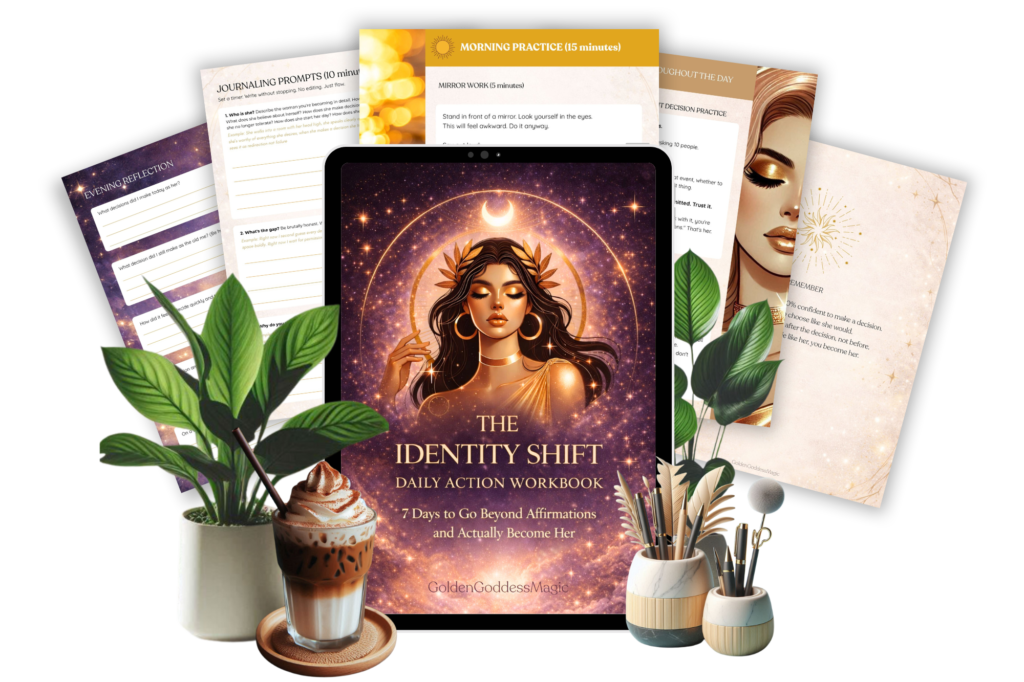
The Identity Shift Workbook was created to guide this process step by step through structured prompts, reflections and daily identity-based practices designed to help you embody your higher self naturally.
✨ You can explore it here